
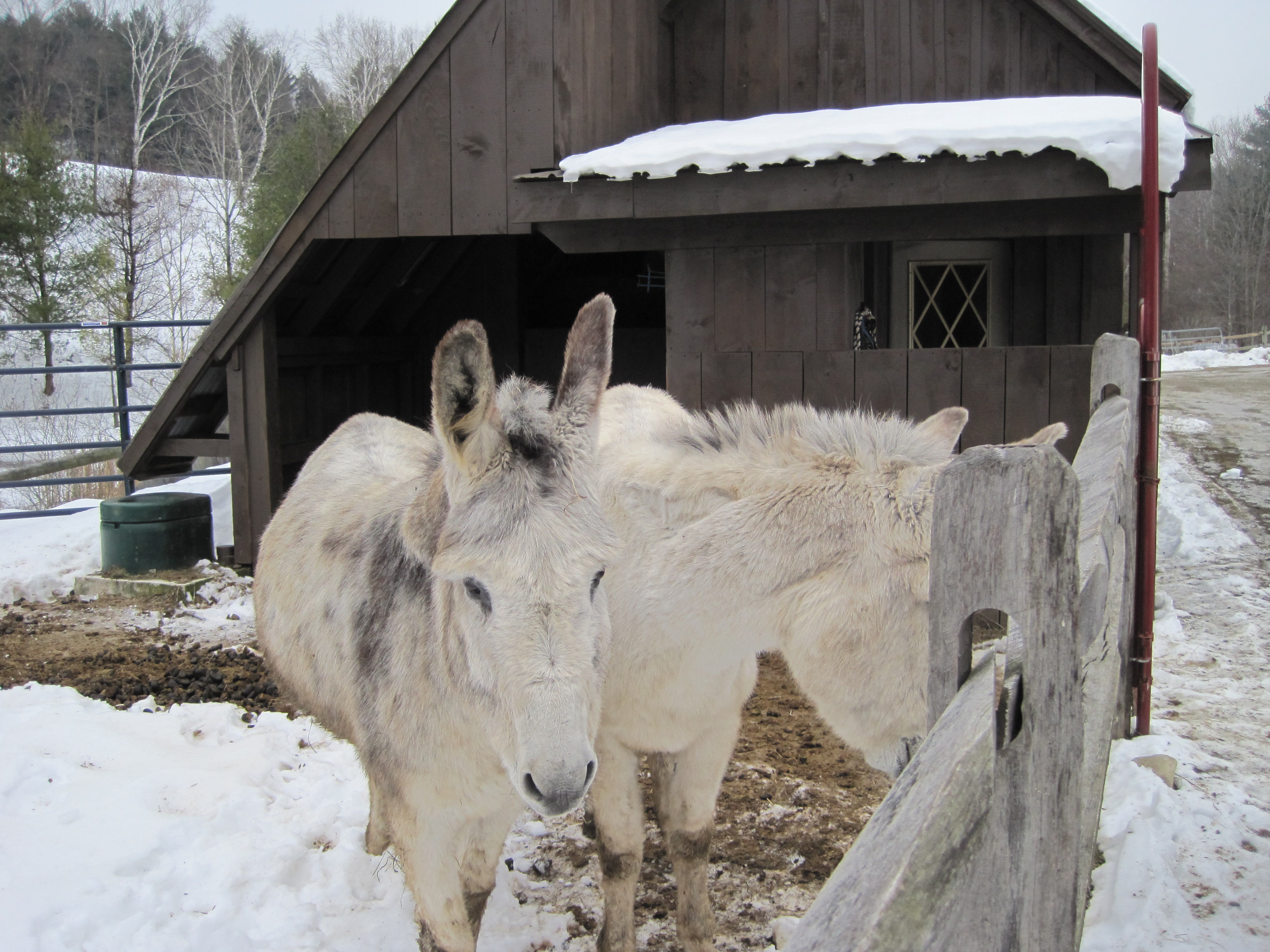
Until a pair of white and grey donkeys appeared on my father’s farm, I didn’t think much about these odd-looking animals. When a donkey shows up anywhere in the world, it’s usually in a political cartoon or a kid’s movie. And let’s face it, the donkey doesn’t typically come out on top land an honorable role in any of these. His cousin, the horse, almost always gets the choice parts. The donkey’s characteristically homely looks, with his long ears, mangy coat, skinny legs and tail, and odd-sounding braying, are entertaining, but hardly put him in the same strata as his sleek and beautiful equine counterparts.
So, these donkeys joined the farm. They blended right into the life of the farm, taking up their main function besides eating, which is to protect the baby calves from predators. They enforce their policing efforts by residing alongside the cows in the fields. When a wolf or coyote stalks the little ones, the donkeys land a combination of loud hee-haws and sharp kicks on it, driving it away from its prey.
Donkeys can also pull a cart and carry a person or small load on their sturdy backs. Small, but strong, donkeys carry out their tasks with a measure of stubbornness and resiliency. You won’t see them prancing and they’re not made for parading. And, of course, we like to poke fun and laugh at them.
In biblical times, though, donkeys were not the target of jokes, but very valuable to society as a primary mode of transportation. Donkeys were important to near eastern society for the same reason vehicles are to us, today. Any car can take us from point a to point b -the car does not have to be a Lexxus with airconditioning and a built-in bar. Donkeys took people from point a to point b, but without the extra style and accessories the upper classes were accustomed to.
The donkey, then, was common, ordinary, and functional. Not for the poorest of society, or for the richest of society. And this animal is precisely what God chose for Jesus to ride into Jerusalem on. Jesus, when he finally turned to Jerusalem and what he knew would be the beginning of events leading to his death, instructed his disciples to find a specific donkey tied up with a colt.
Now when they drew near to Jerusalem and came to Bethphage, to the Mount of Olives, then Jesus sent two disciples, saying to them, “Go into the village in front of you, and immediately you will find a donkey tied, and a colt with her. Untie them and bring them to me. If anyone says anything to you, you shall say, ‘The Lord needs them,’ and he will send them at once.” Matt 21:1-3
The way the text is written, this is all planned out. Jesus is very matter of fact and acts like he is sending his disciples to do an easy task, sending them into a strange village to get a donkey. But it’s all scripted out. The are not required to do a long search, or bargain with the donkey’s owner, or anything. Just go and untie the donkey. With the foreknowledge that this is no coincidence, Jesus confidently stated that there would be a donkey in the village in front of them all prepared and ready. – because God put it there.
This took place to fulfill what was spoken by the prophet, saying, “Say to the daughter of Zion, ‘Behold, your king is coming to you, humble, and mounted on a donkey, and on a colt, the foal of a beast of burden.’” Matt. 21:4-5
God had decided in the master plan – hundreds of years before it was executed that Israel’s king would be humble, and a donkey was the choice for Jesus to ride. And Jesus submitted to the plan, every step of the way.
That ride into Jerusalem was key. Up until this time, Jesus had avoided Jerusalem, knowing that there were people there who wanted to kill him. A new sunrise peeps over the horizon, and he knows, this is the day that he is to go to Jerusalem which will take him, a week later, to death.
So why all of this narrative about getting this donkey? Why was this prophesied hundreds of years in advance? Focusing on the humble, common donkey – an economy car, not a luxury model – may seem trivial in this great story of ultimate redemption in the gospels. After all, what really matters for our salvation is the crucifixion.
I assume that there is always a deeper meaning behind God’s choices. And a donkey is an important part of this story. Is it another example of Jesus’ submission in every detail? His identification with the mainstream of life?
I’m interested in what you think about the essential donkey.
 Consider the Lilies
2 responses to “The essential donkey”
Thoughtful, Janine. The humble common donkey, chosen for the job, reminds me how well that fits the whole story. Jesus chose to disciple some very simple, humble, common fishermen (among others) to carry the Gospel.
Thanks for your comment, Marge. How true, if we could only see ourselves as humble yet chosen…