
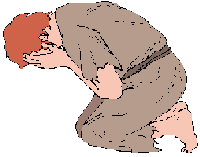
 I wonder – was the consciousness of sin that the king of Israel of old, David, displayed, unique to that era? Today’s mantra,”if it feels good, do it,” is so far from the concept of sin in both the Hebrew and Greek scriptures.. The sins – adultery, lying, murder – that broke the heart of David thousands of years ago, are treated so very lightly in our cultural understanding. So lightly, that some sins that crushed David and caused him much pain and guilt are now widely celebrated.
So, to picture the scene of repentance in Psalm 51, it is hard to reach back for a memory of a similar scene in a film, TV show, or popular novel. David is in pure agony after his adultery with Bathsheba, his cover up of the act, and his manipulation to have her husband killed in battle. Every verse of the first five verses of the psalm is a cry from David describing how, after the fact, he views his actions. And in every verse David pleads for God’s mercy.
The most vivid verse describing David’s feelings of depression and cry for God’s restoration is Psalm 51:8:
“Let me hear joy and gladness; let the bones you have broken rejoice.”
Hebrew poetry is full of imagery, and this image is quite vivid, to me. Having reached the other side of a difficult injury that involved broken bones in my wrist, I can identify with both the excruciating physical pain and the psychological side of having a broken bone. Used to relying on my intact right hand, the broken bone caused me all kinds of helpless feelings. Things I could do without thought were instantly huge, inconquerable tasks. Movements that were easy were wracked with pain.
The joy came when my bones began to heal, and I could pick up a knife and cut vegetables today. What joy at a task that I had always taken for granted. Losing my ability, and regaining it, brought a joy that would not have been there had I never lost it.
David speaks of the bones that God had broken. There is no indication that David sustained a fall or injury, or that this was a reference to a literal fracture. In poetry, any number of meanings can be attributed to an image…and so, my interpretation is that God had allowed David to lose something. His integrity, perhaps. Or his pride. Or his image of himself as a godly man, wholly devoted to God. Maybe he realized how sin ruled his life, for the first time. His view of his life related to the God that he served – that he had always taken for granted – no longer existed.
David, however, in his loss, does not lose his view of God’s ability to restore him. He asks God to change the place of his humiliation and helplessness to a place of rejoicing.
In one breath, one sentence, the complete picture of a holy and loving God emerges. The God who “breaks bones” is the same God who causes those bones to rejoice. The rejoicing comes at a cost. But without the scary, frightening realization that sin is real and I have it, the capacity to rejoice in the miracle of forgiveness is just not the same.
Jesus illustrates this in another way with a story. “But the tax collector, standing far off, would not even lift up his eyes to heaven, but beat his breast, saying, ‘God, be merciful to me, a sinner!’ I tell you, this man went down to his house justified, rather than the other. For everyone who exalts himself will be humbled, but the one who humbles himself will be exalted.” Luke 18:12-14
 Consider the Lilies
One response to “Rejoicing Bones”
The essence of it all isn’t it? Total depravity hiding in us, who said we don’t need a savior?